If you run a restaurant in Bengal, the hills or Bhutan, you’ve probably wondered whether it’s worth contacting a commercial tandoor manufacturer in Murshidabad, or whether any tandoor from any shop will do. Picture Imran. (A made-up name, but the situation is common.) He’s opening a small restaurant, and the menu promises soft naan and smoky tikka. On the first Friday night, the naan slides off the wall, the heat is uneven, and the kitchen fills with smoke. Nothing is wrong with his cooking. The tandoor was simply the wrong one for his kitchen.
This guide explains what a commercial tandoor does, where it fits in a restaurant or hotel kitchen, how to choose one, and what else the kitchen needs around it. At PS Hospitality Services, we’ve kept the language plain, so you can use it when you talk to any supplier.
What is a commercial tandoor?
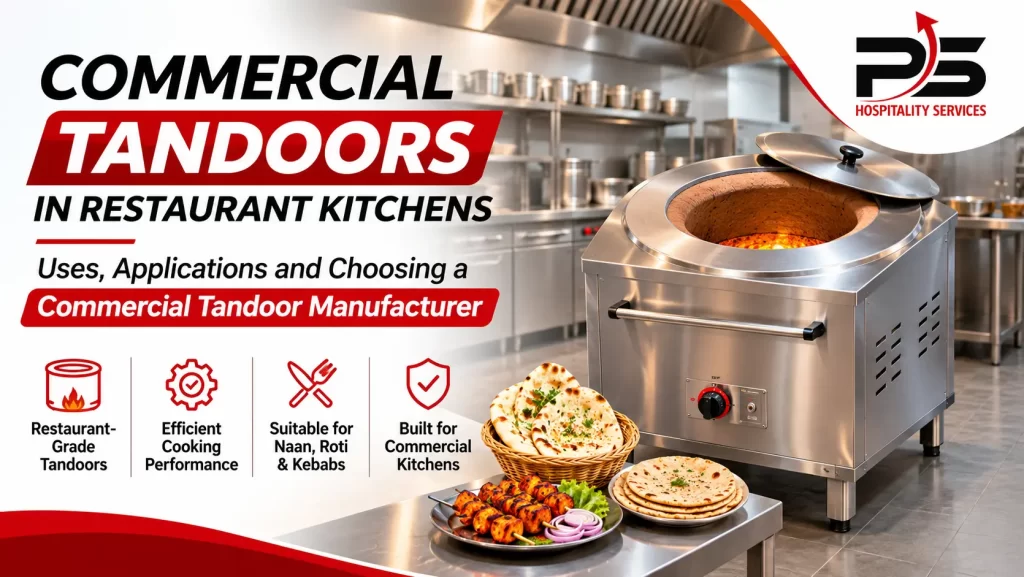
A commercial tandoor is a large, high-heat cylindrical oven used to cook breads and meats on its hot inner walls and over live heat. It’s built for daily restaurant use, with a clay or similar lining inside and a steel body outside. It cooks fast, adds a smoky flavour and handles heavy orders better than a home oven.
In simple words, it’s a deep, round oven where dough is stuck on the wall to bake, and skewers of meat or paneer hang down into the heat. Our Tandoor page shows the product, and the rest of this guide explains how to think about it.
Detailed Specifications of a Commercial Tandoor
A commercial tandoor is designed to support regular cooking requirements in restaurant and hotel kitchens. PS Hospitality Services offers a tandoor with a Chinese Burner and 1BS configuration, available in both round and square designs. The round tandoor measures 24 inches in diameter and 34 inches in height. Square tandoor options are available in three sizes: 24 × 24 × 34 inches, 30 × 30 × 34 inches and 36 × 36 × 34 inches. These size options allow restaurant owners to choose a model according to their available kitchen space and cooking requirements. The product starts at ₹22,500, with the final price depending on the selected size and configuration. Before ordering, confirm the exact model specifications, installation requirements and pricing with the supplier.
What a tandoor is used for in a restaurant kitchen
Most people think of naan, but a good tandoor does a lot more. Here’s where restaurants typically use one:
- Breads: naan, roti, kulcha, lachha paratha.
- Tikkas and kebabs: chicken tikka, paneer tikka, seekh kebab, malai tikka.
- Whole items: tandoori chicken, whole fish, roasted vegetables.
- Smoky starters: the dishes that make your menu stand out.
- Banquets and events: a tandoor can turn out a large number of breads and starters in a short time, which is why hotels rely on it.
For many restaurants, the tandoor is the main attraction. Guests can smell it, see it and often order because of it.
Local Tandoor vs Commercial Tandoor: What Is the Difference?
A local tandoor may be suitable for small food outlets with limited cooking requirements, while a commercial tandoor is designed for the regular demands of restaurant and hotel kitchens. The differences generally depend on construction, available sizes, burner configuration and intended usage.
| Comparison Factor | Local Tandoor | Commercial Tandoor |
| Construction | May have a basic or locally assembled design | Designed for regular commercial kitchen use |
| Available Sizes | Options may be limited | Available in different sizes and configurations |
| Burner Configuration | Depends on the individual model | May include specific burner configurations, such as Chinese Burner with 1BS |
| Cooking Requirements | Suitable for smaller-scale requirements | Suitable for restaurant and hotel cooking needs |
| Design Options | Depends on local availability | Options may include round and square designs |
| Price | Varies by size and construction | Depends on the selected model and specifications |
| Best Suited For | Small food outlets and limited-use kitchens | Restaurants, hotels and commercial kitchens |
The right choice depends on your menu, daily order volume, kitchen space and budget. Before selecting a tandoor, compare the specifications of individual models and choose one that matches your kitchen’s actual requirements.
Charcoal, gas or electric: which tandoor suits you?
A charcoal tandoors give the classic smoky taste but need fuel handling and good ventilation. Gas tandoors are easier to control and clean. Electric tandoors avoid open flame and suit tighter spaces, though the flavour can be milder.
- Charcoal: the traditional choice. Best flavour, but more work, more smoke and more cleaning.
- Gas: quick to heat and easy to control. A popular choice for busy kitchens.
- Electric: no open flame, so it suits places with fuel or ventilation limits.
The right choice depends on your menu, your space and how much smoke your kitchen can safely handle. A sensible manufacturer will ask about these before they quote.
How to choose a commercial tandoor manufacturer in Murshidabad
A reliable commercial tandoor manufacturer in Murshidabad should be able to answer practical questions without fuss. Before you pay, ask:
- What material is the outer body, and how thick is it?
- How is the inner lining made, and how is it insulated?
- Which fuel types are available, and what size suits my daily orders?
- How long does the first heating and curing take?
- What does the warranty cover, and who repairs it locally?
- Can I see a tandoor that’s been in use for a while?
If you’re comparing options in the district, see our page on Commercial Kitchen Equipment in Murshidabad. A commercial tandoor manufacturer in Murshidabad who builds locally can also repair locally, which matters when a tandoor is the heart of your menu.
Buying a tandoor in Siliguri and the hills
North Bengal and Sikkim bring their own questions. A commercial tandoor supplier Siliguri owners trust should be able to explain delivery, installation and servicing, because hill roads and cold weather make all three harder.
If your restaurant is higher up, ask extra questions:
- Darjeeling: is there local help for repairs? Our page on a Commercial Kitchen Equipment Manufacturer in Darjeeling is a good starting point.
- Pelling: how will the tandoor reach you, and who installs it? Ask any commercial tandoor manufacturer in Pelling about transport and breakage.
- Bhutan: ask about cross-border delivery, paperwork and spare parts before you order from any commercial tandoor manufacturer in Bhutan.
- Cold weather and altitude: ask whether the burner and fuel suit your height and temperature.
For delivery to your exact location, including hill towns and Bhutan, please confirm directly with the team at PS Hospitality Services before you place an order. We’d rather tell you what’s possible than promise something that doesn’t work on your road.
Hotel Kitchen Equipment that works alongside a tandoor
A tandoor never works alone. Here’s the rest of the Hotel Kitchen Equipment a typical restaurant or hotel kitchen needs, in plain words:
- Tawa or griddle: a flat hot plate for parathas, tikki, pav bhaji and dosa.
- Kadai stand: a strong stand that holds a heavy kadai over a flame.
- Handi (hendi): the round-bellied pot used for biryani, dal and curries.
- Storage racks: steel shelves that hold sacks, tubs and pots off the floor.
- Cutting table and chopping table: work tables where ingredients are cut, with the chopping table built tougher for heavy cleaver work.
- Deep fridges (deep freezers): cold storage for meat, paneer and frozen stock.
- Sinks and SS wash basin: steel basins for washing food, vessels and hands.
- Bain-marie: a hot water tray that keeps gravies and rice warm for service.
- Salad counters: chilled counters that keep salad and toppings fresh and within reach.
- Service trolleys: wheeled carts that move dishes between kitchen and dining room.
- Dosa plates: flat hot plates made for dosa.
- Idli steamers: steam racks for cooking idli in batches.
- Chapati machines: machines that speed up roti and chapati when orders are high.
If your menu leans towards bakery items, our Bakery Kitchen Equipment page lists the main tools. A Planetary Mixer is useful for kneading large batches of naan and kulcha dough evenly, and it can help bakery items as well. A Planetary Mixer saves hours of hand kneading each week.
Planning the kitchen layout around your tandoor
Where you place the tandoor affects everything else. A few habits help:
- Keep the tandoor near the pass, so breads reach the table hot.
- Leave clear space around it. Heat, hot tools and busy staff are a risky mix.
- Put the dough and prep area close by, so cooks aren’t walking with trays.
- Keep cold storage away from the heat.
- Plan ventilation before you install, not after.
For a fuller view, our Restaurant Kitchen Equipment page lists the main categories. For curries and everyday stovetop dishes, a 4 Burner Continental range sits well beside a tandoor, and the two together can cover most of a North Indian menu. Leave enough room around the 4 Burner Continental for several pans at once.
Looking after a commercial tandoor
A tandoor lasts longer with simple care:
- Heat it slowly the first time. A new clay-lined tandoor needs gentle first heating, as the maker advises, so the lining doesn’t crack.
- Ventilate well. Smoke and heat should leave the kitchen, not hang in it.
- Clean after every shift. Remove ash and food scraps once the tandoor has cooled.
- Keep it dry. Moisture is hard on the lining, particularly during the monsoon.
- Use proper tools. Long, sturdy skewers and tongs keep hands away from the heat.
- Check gas connections and fittings regularly. For gas models, get any leak checked by a professional.
A short checklist before you order
- Decide on the fuel: charcoal, gas or electric.
- Match the size to your daily orders, not your best day ever.
- Ask about the lining, insulation and warranty.
- Confirm delivery, installation and who services it.
- Plan ventilation and the layout.
- Get everything in writing, including price and timelines.
Why you can trust this guide
This guide comes from the team at PS Hospitality Services, who work with restaurant and hotel kitchens. We’ve written it from the questions kitchen owners ask us, and where an answer depends on your menu, your space or your location, we’ve said so. It was last reviewed in November 2026. Specifications, prices and delivery should always be confirmed in writing before you buy.
Frequently asked questions
What is a commercial tandoor used for?
It’s used to cook naan, roti, kulcha, tikkas, kebabs and tandoori chicken at high heat, in large quantities and with a smoky flavour. Restaurants and hotels rely on it for busy service.
What are the types of commercial tandoor?
The main types are charcoal, gas and electric. Charcoal gives the classic smoky taste, gas is easier to control and clean, and electric avoids open flame.
How do I choose a commercial tandoor manufacturer in Murshidabad?
Ask about the body material, lining, insulation, fuel options, warranty and local repair. Visit a kitchen that has used their tandoor for a while.
Where can I find a commercial tandoor supplier Siliguri restaurants trust?
Look for a supplier who can explain delivery, installation and servicing for North Bengal, and who will show you a tandoor that’s been in use. Ask for everything in writing.
Is there a commercial tandoor manufacturer in Darjeeling or Pelling?
Availability varies, so ask each supplier about local repair, transport and installation. For the hills, delivery and servicing matter as much as the tandoor itself.
Can I buy a commercial tandoor in Bhutan?
Some suppliers deliver across the border, but paperwork, transport and spare parts need to be confirmed before you order. Ask for the full process in writing.
What other Hotel Kitchen Equipment do I need with a tandoor?
Most kitchens also need a tawa, kadai stand, storage racks, cutting and chopping tables, deep fridges, sinks, a bain-marie and service trolleys, depending on the menu.
How do I take care of a tandoor?
Heat it slowly the first time, clean it after each shift, keep it dry, ventilate well and use proper tools.
Let’s plan your kitchen
Imran replaced that first tandoor with one sized for his kitchen, put a cutting table and a steel rack where they belonged, and stopped dreading Friday nights. If you’d like help planning yours, get in touch with the team at PS Hospitality Services through our website. Tell us your menu, your space and your location, and we’ll help you decide what to buy and what can wait.